The Reliability Trap: What Chasing Nine-Nines Is Actually Costing Your Engineering Organization
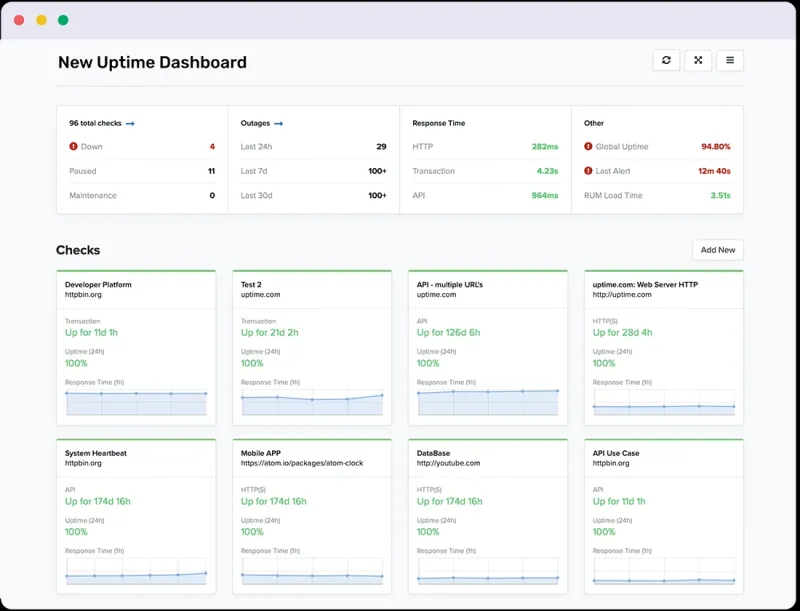
Photo: server uptime monitoring dashboard reliability infrastructure, via uptime.com
There is a number that appears in enterprise contracts, sales decks, and infrastructure planning documents with remarkable consistency: 99.9%. Sometimes it is 99.95%. Increasingly, it is 99.99%. These figures carry a kind of mathematical authority that makes them feel like objective engineering targets rather than negotiated business decisions. They are not. And treating them as though they are is one of the more expensive mistakes a technology organization can make.
The hidden economics of availability commitments deserve a more rigorous examination than most engineering teams apply to them.
What the Nines Actually Cost
The arithmetic of availability is well understood. 99.9% uptime permits roughly 8.7 hours of downtime per year. 99.99% permits approximately 52 minutes. The gap between those two targets is not a rounding error — it is an engineering program.
Moving from three nines to four nines typically requires redundant infrastructure across availability zones, active-active failover configurations, automated health checks with sub-minute response times, on-call rotations with defined escalation paths, runbooks for dozens of failure scenarios, and chaos engineering practices to validate that the redundancy actually functions under realistic failure conditions. Each of these components carries an ongoing maintenance burden. Each generates alerts, incidents, and post-mortems. Each requires engineering time that is not being spent on product features.
For a well-funded infrastructure team at a large enterprise, this overhead may be entirely justified. For a growth-stage software company with a twelve-person engineering team, the same availability commitment can quietly consume thirty to forty percent of total engineering capacity — not in a single dramatic budget line, but distributed invisibly across on-call rotations, reliability sprints, and the accumulated weight of infrastructure that exists solely to honor a contractual percentage.
The SLA as a Sales Instrument
Availability targets frequently originate in sales conversations rather than engineering assessments. A prospective enterprise customer requests 99.99% uptime. The sales team, eager to close the deal, commits. The contract is signed. The engineering team inherits the obligation.
This sequence is not inherently problematic — enterprise customers have legitimate reliability requirements, and meeting them is a reasonable business objective. The problem arises when availability commitments are made without a corresponding analysis of what those commitments will cost to honor, and whether the revenue generated by the contract justifies the engineering investment required to meet its terms.
In practice, many organizations discover the true cost of an SLA commitment only after they have begun building the infrastructure to support it. By that point, the contract is signed, the customer expectation is set, and the engineering team is committed to a reliability program whose scope was never fully evaluated.
Redundancy Patterns and Their Hidden Overhead
The infrastructure patterns required to support high availability targets are individually reasonable. Multi-region deployments protect against regional outages. Database replication provides durability and read capacity. Circuit breakers prevent cascading failures. Load balancers distribute traffic and reroute around unhealthy instances.
The challenge is that each of these patterns introduces its own operational surface area. Multi-region deployments require engineers to reason about data consistency across geographic boundaries — a problem that is straightforwardly hard and that generates a category of bugs that are notoriously difficult to reproduce in development environments. Database replication introduces replication lag, which creates read-after-write consistency issues that surface unpredictably under load. Circuit breakers require careful calibration; misconfigured thresholds can cause healthy services to be marked unhealthy during traffic spikes, converting a performance degradation into a full availability incident.
None of this is a reason to avoid these patterns. It is a reason to account for their ongoing cost honestly when evaluating whether a given availability target is worth pursuing.
The Incident Response Tax
High availability commitments do not merely require infrastructure investment — they require organizational investment in incident response. Maintaining four nines means detecting, triaging, and resolving incidents within a window that leaves almost no margin for slow escalation paths or unclear ownership.
This drives the creation of on-call rotations, incident management tooling, escalation runbooks, and communication protocols. Each of these is a legitimate engineering practice. Collectively, they represent a significant and ongoing commitment of engineering attention. On-call engineers who are paged at 2:00 AM to investigate a latency spike are engineers who will be less productive the following day. Teams that spend their Fridays managing production incidents are teams that are not closing sprint tickets.
The psychological toll of sustained on-call pressure is also a factor that engineering leaders often underestimate until attrition makes it impossible to ignore. The organizations that are most aggressive about availability commitments are frequently the ones that struggle most with engineering retention — not because reliability work is inherently undesirable, but because the volume and urgency of that work, when it exceeds a sustainable threshold, degrades the working conditions of the engineers responsible for it.
When Lower Availability Is the Right Answer
The framing of availability as a target to maximize is itself worth interrogating. For systems where downtime directly translates to revenue loss — payment processing, real-time inventory management, customer-facing transaction platforms — high availability targets are clearly justified. The cost of downtime exceeds the cost of preventing it.
For other systems, that calculus is less clear. An internal analytics dashboard that serves fifty business users does not require the same availability infrastructure as a customer-facing API. A batch processing pipeline that runs nightly can tolerate failure modes that would be unacceptable in a synchronous request-response system. A development environment, by definition, should not be held to production availability standards.
Engineering organizations that apply uniform availability targets across their entire system portfolio are paying reliability costs that are not proportional to business value. Intentionally accepting lower availability targets for lower-criticality systems is not a compromise — it is a resource allocation decision that frees engineering capacity for work that delivers greater return.
Renegotiating the Reliability Contract
For engineering leaders who have inherited availability commitments that are consuming disproportionate roadmap capacity, the path forward involves a conversation that most organizations are reluctant to initiate: renegotiating the terms of the reliability contract.
This does not necessarily mean renegotiating SLAs with customers — though that is sometimes the appropriate outcome. It means establishing internal clarity about which systems require which availability targets, what the true cost of each target is, and whether that cost is justified by the business value the system delivers.
Deploying faster and scaling further requires knowing which reliability investments are genuinely load-bearing and which are organizational inertia dressed up as engineering discipline. The organizations that answer that question honestly are the ones that retain the engineering capacity to build what their customers actually need.